
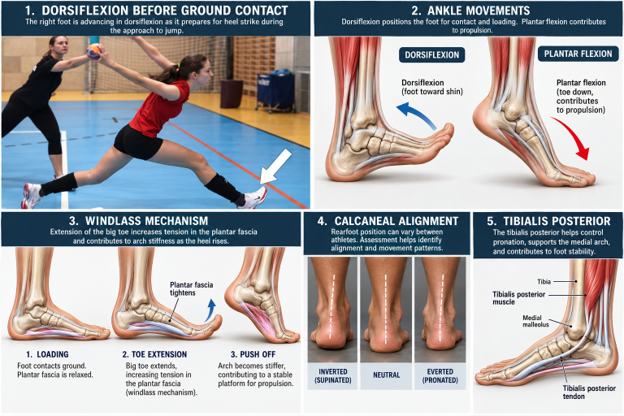
Understanding how the foot receives force, adapts to loading, and prepares the body for explosive takeoff.
When volleyball coaches discuss jumping higher, the conversation usually centers on developing stronger quadriceps, glutes, and calves.
Those muscle groups are important. But after more than 30 years of working with human movement, I’ve learned to look more closely at something that often receives less attention.
What happens when the athlete’s foot first contacts the ground?
Before an athlete can jump, the body must manage the forces associated with the approach, position the lower extremities, and prepare for takeoff.
That process begins with the feet.
The foot and ankle are not simply structures that connect the body to the floor. They participate in accepting loads, adapting to the ground, controlling movement, and contributing to propulsion.
And one of the movements that deserves particular attention is ankle dorsiflexion.
Understanding Dorsiflexion Before Ground Contact
Ankle dorsiflexion occurs when the foot moves toward the shin or when the shin advances over a planted foot.
Both involve dorsiflexion, but they occur under different mechanical conditions.
Consider a volleyball player approaching the net to jump.
During one of the final approach steps, the athlete’s right leg may advance forward while the left leg trails behind.
As the right foot prepares for a heel-first contact, the ankle is positioned in dorsiflexion.
This is different from the dorsiflexion that occurs when the tibia advances over a planted foot during a squat or countermovement.
Here, we’re examining the position of the foot before it contacts the floor and how that position influences the subsequent loading sequence.
Dorsiflexion helps position the foot for contact. It does not independently generate jumping power, but it is one component of the athlete’s preparation for receiving and managing force.
Not every volleyball approach uses the same foot-contact pattern. Heel-first, flatter-footed, and forefoot-biased contacts may occur depending on the athlete and the step being performed.
Our goal is to understand the mechanics of the individual athlete rather than assume everyone must use an identical technique.
The Calcaneus: Where Force Acceptance May Begin
When an athlete makes heel-first contact, the calcaneus—the heel bone—is the initial skeletal region involved in accepting the external load.
But the calcaneus doesn’t work alone.
The heel pad, joints, muscles, tendons, ligaments, and surrounding tissues all contribute to the body’s response.
The position of the calcaneus at contact is one factor worth examining.
Is the rearfoot relatively neutral?
Is it positioned in inversion or eversion?
How does it move as the athlete accepts weight?
A relatively neutral calcaneal position can provide a useful reference point during postural assessment. However, there is no single rearfoot position that has been established as ideal for every athlete during every jumping task.
What matters is not simply where the calcaneus begins.
We also want to understand how the athlete controls the movement that follows.
An athlete whose calcaneus appears everted during standing may have different loading demands from an athlete whose calcaneus appears relatively neutral.
But foot posture alone does not establish whether the athlete is strong, weak, efficient, or inefficient.
Those questions require additional assessment.
From Rearfoot Contact to Midfoot Adaptation
As the athlete accepts loading, movement occurs across several joints of the foot and ankle.
The rearfoot may begin in a relatively supinated position and move toward pronation as loading progresses.
Pronation is a coordinated three-dimensional movement involving several joints. It is not simply the collapse of the arch or the outward movement of the calcaneus.
The midfoot also participates in adapting to loading.
This is important because the foot must accommodate forces while maintaining sufficient control to support the athlete’s next movement.
If the foot is too rigid for the task, its ability to adapt may be limited.
If the athlete has difficulty controlling excessive or poorly timed movement, the demands placed on surrounding structures may increase.
Neither observation can be established from a static photograph alone.
The question is whether the athlete has the movement capacity and control required for the demands of the sport.
The Tibialis Posterior and Foot Control
One muscle I pay particular attention to when examining foot mechanics is the tibialis posterior.
This muscle contributes to controlling pronation-related motion, supporting the medial longitudinal arch, and influencing rearfoot and midfoot mechanics.
During loading, it works with other muscles and passive structures to help manage movement.
As the athlete transitions toward propulsion, the foot must provide a sufficiently stable structure for forceful push-off.
The tibialis posterior is one contributor to that process.
But it is not working independently.
The fibularis muscles, tibialis anterior, gastrocnemius, soleus, intrinsic foot muscles, plantar fascia, and other structures all influence the mechanical behavior of the foot and ankle.
When I observe an athlete with a pronated foot posture, I become interested in how those structures are functioning.
I do not automatically conclude that the tibialis posterior is weak.
Instead, I ask:
Does the athlete have the strength, mobility, and movement control needed to manage loading effectively?
That distinction matters.
A postural observation can raise an important question, but it cannot answer every question about muscular function.
Why I Begin With a Postural Assessment
Before evaluating how an athlete jumps, I want to understand how that athlete stands.
I begin by observing foot placement and the relationship between the feet, ankles, knees, hips, and pelvis.
I’m interested in several things:
- The resting alignment of the calcaneus.
- Differences between the right and left feet.
- Medial arch position and navicular movement.
- The relationship between rearfoot and forefoot alignment.
- Tibial position and foot progression angle.
- The athlete’s overall standing posture.
This gives me a starting point.
It does not tell me everything about the athlete’s performance.
A person may demonstrate a particular foot posture in standing but use a different movement strategy when running, jumping, or landing.
That’s why I believe postural assessment should be followed by dynamic movement assessment.
Moving Beyond Static Posture
After examining posture, I want to observe how the athlete uses the foot and ankle during movement.
Can the athlete dorsiflex the ankle while maintaining appropriate foot contact?
Can the rearfoot move through available inversion and eversion?
How does the midfoot respond when weight shifts across the foot?
Can the athlete perform a controlled heel raise?
Can the athlete balance and control movement on one leg?
Are there noticeable differences between the right and left sides?
These observations help develop a more complete picture.
But they also reveal a limitation.
Watching an athlete perform a movement does not necessarily tell us how much force the athlete can produce or how effectively the muscles are controlling that movement.
This is one of the reasons I believe movement assessment must continue to evolve.
The Transition From Loading to Propulsion
During a volleyball approach jump, the athlete must manage horizontal momentum while preparing to accelerate vertically.
The final approach steps help position the body for takeoff.
As the foot contacts the floor, the lower extremities contribute to braking, supporting body weight, and redirecting movement.
The ankle, knee, and hip work together.
As the athlete progresses toward propulsion, loading may shift toward the forefoot.
The metatarsophalangeal joints, particularly the big toe joint, can extend as the heel rises.
This extension contributes to the windlass mechanism, which increases tension in the plantar fascia and influences the mechanical stiffness of the foot.
The toe flexors and intrinsic foot muscles also participate in stabilizing the foot and managing loading.
Meanwhile, the gastrocnemius and soleus contribute to ankle plantar flexion and the production of propulsive force.
The Achilles tendon can store and return elastic energy during dynamic movements.
These actions overlap rather than occurring as completely separate steps.
And the foot does not create the entire jump by itself.
Jumping performance depends on the coordinated contributions of the foot, ankle, knee, hip, trunk, and upper extremities.
Receive. Organize. Transfer. Output.
Throughout my career, I’ve developed a way of looking at movement through four interconnected principles.
These principles form the foundation of Movement Revelation™.
Receive™ — How Does the Body Accept Force?
During the approach jump, the athlete’s feet contact the ground and the lower extremities respond to the external loading demands.
I want to understand how the athlete is positioned and what happens as that loading begins.
Organize™ — How Does the Body Control Movement?
The foot and ankle must coordinate with the knee, hip, pelvis, and trunk.
The athlete must control joint positions, movement velocities, and the transition between loading and propulsion.
Transfer™ — How Does the Body Coordinate Mechanical Demands?
Muscular forces, joint moments, and interactions between body segments influence the movement.
The question becomes how the athlete coordinates these mechanical demands as the body transitions toward takeoff.
Output™ — How Does the Athlete Express Performance?
The athlete produces the net impulse necessary to accelerate the body’s center of mass and leave the floor.
Jump height is one expression of performance.
But I also want to consider consistency, coordination, and the demands involved in producing that jump.
These four principles are an educational framework, not four independent biomechanical phases.
They help organize the questions we ask about movement.
Two Athletes Can Jump the Same Height and Move Differently
Imagine two volleyball players who achieve the same vertical jump height.
One may rely more heavily on ankle contribution.
The other may produce a greater proportion of mechanical work at the knee and hip.
Their foot positions, movement timing, and loading strategies may also differ.
Does that automatically mean one athlete is moving incorrectly?
No.
Athletes naturally demonstrate different movement strategies.
But those differences deserve investigation.
I want to know whether the athlete’s movement strategy is appropriate for the task and whether there are meaningful limitations that could be addressed through individualized training.
Jump height tells us what the athlete accomplished. It does not, by itself, explain how the athlete accomplished it.
Why Observation Alone Is Not Enough
This is one of the most important lessons I’ve learned from working with human movement.
We can observe posture.
We can measure range of motion.
We can watch an athlete jump.
We can identify visible differences between the right and left sides.
But those observations do not necessarily tell us how much torque an athlete can generate, how effectively movement is controlled under load, or which individual muscles contribute to that control.
Researchers have developed valuable technologies, including force plates, motion capture, electromyography, and dynamometry, to investigate different aspects of human movement.
Each provides useful information.
But no single assessment tells us everything.
We must distinguish what we can observe from what we can actually measure.
And we must be willing to acknowledge when an observation leads to a hypothesis rather than a proven conclusion.
I believe that distinction is essential if we want to advance the science of movement.
What Should Volleyball Coaches Look For?
Coaches don’t need to become biomechanical researchers to appreciate the importance of foot and ankle function.
But I believe there are valuable questions worth considering.
Does the athlete demonstrate meaningful differences in foot posture between the right and left sides?
Does the athlete have adequate ankle mobility for the movement being performed?
Can the athlete control loading during single-leg and double-leg activities?
Does the athlete consistently use the same approach mechanics?
Are there changes in foot placement, trunk position, or lower-extremity coordination as the athlete becomes fatigued?
And perhaps most importantly:
Are we addressing the individual athlete’s movement needs, or are we assuming that every athlete should move exactly the same way?
Coaches can use these observations to guide conversations with qualified movement and sports performance professionals.
They should not be used in isolation to diagnose injuries or muscular dysfunction.
My Perspective: Before We Ask Athletes to Jump Higher, Understand How They Move
After more than 30 years of working with athletes and active individuals, I have become increasingly interested in the relationship between posture, movement control, and athletic performance.
The ankle is a good example of why these relationships deserve attention.
An athlete may have adequate dorsiflexion but struggle to coordinate movement during demanding activities.
Another athlete may demonstrate a mobility restriction that changes how the body prepares for takeoff.
A third athlete may have a particular foot posture but demonstrate excellent control and jumping performance.
We cannot assume that the same observation means the same thing for every person.
That is why I begin with assessment.
I want to understand the individual standing in front of me before deciding which aspects of movement deserve greater attention.
And I believe we should continue asking better questions about the mechanical capabilities behind what we see.
Before we ask an athlete to produce more force, we should understand how that athlete is positioned to receive it, control movement, and coordinate the body during performance.
That is the perspective I want to advance through Movement Revelation™.
Because measuring how far the body moves is valuable.
Understanding how the body manages movement gives us a more complete picture.
