
What 30 Years of Working With the Human Body Have Taught Me
After more than 30 years of working with the human body, I’ve learned something that has fundamentally shaped the way I approach movement.
Where a person experiences discomfort isn’t necessarily where the movement problem begins.
That realization changed the questions I began asking. Instead of focusing exclusively on where someone hurts, I became increasingly interested in understanding how their body moves, how different joints work together, and how limitations in one area might influence another.
The more people I worked with, the more I recognized an important distinction:
Having the ability to move is not the same as having the ability to control movement.
That distinction has become one of the foundations of Movement Revelation™.
When a Client’s Experience Becomes Part of a Bigger Conversation
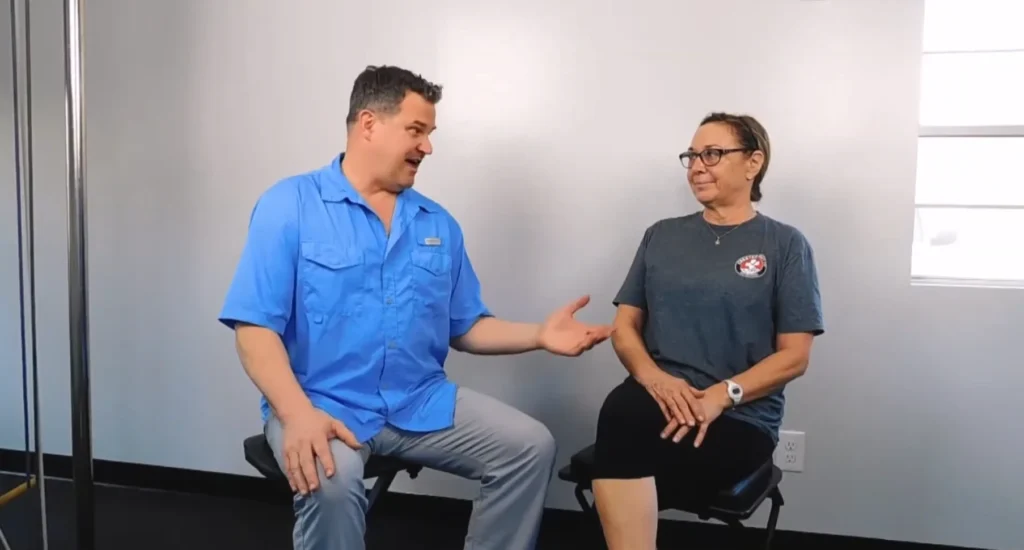
In May 2019, Ashley Woody shared a video testimonial about her experience with the Bosch Activation Method, the approach I was using at that time.
Ashley’s experience is meaningful to me because it reflects the human side of movement work. People don’t always come looking for a detailed explanation of biomechanics. They often want to feel more comfortable, move with greater confidence, or participate more fully in activities that matter to them.
Her testimonial is one person’s account of her experience with my earlier work. It is not scientific proof that a particular method works for everyone, and I wouldn’t present it that way.
But it does raise a larger question:
What can we learn about the way the body functions that might help us approach movement differently?
The Body Doesn’t Move as a Collection of Independent Parts
Consider something as ordinary as walking. Each time the foot contacts the ground, a series of coordinated movements occurs throughout the body.
The foot and ankle adapt to the surface and loading demands. The knee and hip contribute to controlling the lower extremity. The pelvis and trunk participate in maintaining balance and coordinating forward movement.
These movements aren’t isolated events. They are part of an interconnected process.
Now consider what happens when someone has limited ankle dorsiflexion, restricted hip rotation, or difficulty controlling the foot as weight shifts across it. The body may adapt by changing movement somewhere else.
Those adaptations are not automatically harmful. Compensation is a normal part of human movement. But understanding when an adaptation is useful, when it becomes limiting, and how it influences performance is an important part of movement assessment.
We cannot fully understand a movement limitation by looking only at the joint where someone feels discomfort.
Mobility Is Only Part of the Equation
One of the most interesting things I’ve observed throughout my career is that people can demonstrate adequate range of motion yet struggle to control that movement.
For example, someone may be able to move their foot into inversion or eversion. But what happens when we ask them to stop that motion at a particular point?
- Can they maintain the position?
- Can they reverse direction smoothly?
- Can they control the movement without relying on excessive compensation elsewhere?
These are different questions from simply asking how far a joint can move, and they show why movement assessment should consider more than flexibility alone.
Range of motion tells us what movement is available. Strength, coordination, and motor control help determine how that movement can be used.
Four Principles That Shape My Understanding of Movement
Over the years, I’ve organized my thinking around four interconnected principles. Together, they form the conceptual foundation of Movement Revelation™.
Receive™ — How the Body Accepts Force
Every step, landing, and change of direction places demands on the body.
Organize™ — How the Body Coordinates Its Response
The nervous system and musculoskeletal system work together to manage joint position, muscular activity, and stability.
Transfer™ — How Force Moves Through the Body
Movement involves interactions among multiple joints and body segments.
Output™ — How the Body Expresses Movement and Performance
Walking, running, jumping, rotating, and changing direction all require coordinated muscular action.
These principles also shape the questions I continue to explore about human performance.
Why Movement Control Deserves More Attention
Consider two athletes with a similar available range of motion. Although both may achieve the same degree of dorsiflexion, their ability to manage resistance, control movement speed, and maintain stability throughout that range may differ considerably.
But one athlete may control movement smoothly throughout that range, while the other struggles to stabilize, decelerate, or reverse direction. A conventional range-of-motion measurement alone would not fully describe those differences.
This doesn’t mean range-of-motion measurements are unimportant. It means they’re one part of a larger picture.
I believe that examining how people manage movement—not simply how far they move—can provide useful information when designing individualized mobility, strengthening, and performance programs.
From Hands-On Experience to Movement Revelation™
My understanding of movement didn’t develop from a single observation or one client’s experience. It developed through decades of hands-on work: asking questions, studying movement, working with individuals of different ages and abilities, and examining why people respond differently to physical challenges.
Some of my most valuable lessons came from observing what people struggled to do, not simply what they could do.
- Why could one person move through a particular range smoothly while another struggled?
- Why could someone demonstrate flexibility but lack control?
- Why did changing one movement demand sometimes reveal limitations that weren’t obvious during another?
These questions helped shape Movement Revelation™. The purpose isn’t to suggest that every movement problem has a simple explanation. It’s to encourage a more complete understanding of the relationship between mobility, strength, coordination, and human performance.
The Bigger Lesson
Personal experiences like Ashley’s matter. They remind us that behind every assessment and every movement observation is a person hoping to improve some aspect of life.
Understanding movement is the beginning of making more informed decisions about how we move. That is the conversation I want to advance through Movement Revelation™.
After more than three decades in this profession, I continue to believe that one of the most valuable questions we can ask is:
Not simply, “How far can you move?” but “How well can you control the movement you have?”
